A script is read into sections and parts, with slides, script tags and notes at their words; you choose the shots.
A script is the text the presenters read, with stage directions between the lines. Live Producer Platform reads it into sections in order, each holding parts. The Studio shows it, read-only, in the Script window.
Where a script is read
Section titled “Where a script is read”A show starts on the web, and only there. You give Live Producer Platform the script as Word, PDF, Excel or CSV, Markdown or text. Spelvin reads it and finds the sections, also where the script has no headings; a name it makes up is marked as suggested. Without Spelvin, built-in rules read it and start a section at each heading. A script processor skill can tell Spelvin what a run sheet’s columns mean. The Studio never reads or edits the script itself.
From then on the show is written on the web, in the script editor: one script the team writes together, at the same time, with the parts, slides, script tags and notes as tags in the words. The directions below are what a script file uses, and what you can still type there; what the Studio receives is read from the tags.
Sections
Section titled “Sections”A section is a block of the show, such as “2. HR update”. It has a number, a title, a planned time and its people. A section can have a start time (“we go live at 16:00”).
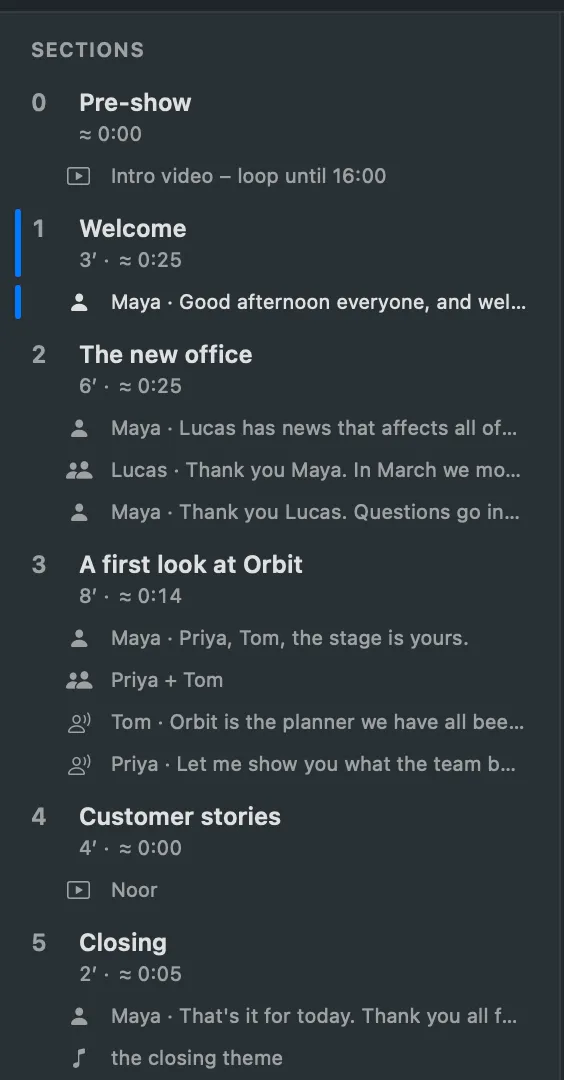
A part is one stretch inside a section, started by a stage direction. Each part has a kind:
| Kind | Example direction | What happens |
|---|---|---|
| Host | [Maya as host] |
The host on camera |
| Live | [Lucas live] |
Presenters live, often in a window of another app |
| Speaker | [TOM starts speaking] |
Another speaker, same picture |
| Recording | [Recording Noor] |
A recorded clip plays |
| Video | [Intro video – loop until 16:00] |
A video plays, or loops |
| Poll | [Poll results] |
The poll page |
| Outro | [Cue outro: …] |
The closing music |
A live part can have its recording as a fallback: [Lucas live, recording as fallback]. The
words after a direction are what is spoken; they go to the prompter and give a time estimate.
Notes, slide marks and links
Section titled “Notes, slide marks and links”[Note: …] is a note for the operator, not a part. [Note to presenter: …] also shows on the
prompter, [Note to crew: …] on the phone remote. New slide ---- moves the slides to the next
slide and Click ---- is a build on the same slide. A line that is a label and a web address
becomes a link of the show.
## 2. The new office (6' – Maya / Lucas)
[Maya as host]
Lucas has news that affects all of us. Lucas, over to you.
[Lucas live, recording as fallback]
[Lower third: Lucas]
Thank you Maya. In March we move to the new office by the river.
New slide ----
Script tags
Section titled “Script tags”Script tags say what the script asks for at a word: a shot, a lower third, a graphic, a sound or an interaction, with the person, label or file it needs. They are guidance: the Script window and the prompter show them at their words, and nothing fires, cues or takes by itself. They also tell the Studio what the show needs; see Setup from the script.
In a script file, and in a script your AI writes, a script tag is a line in brackets with its
kind and what it needs, before the paragraph it belongs to: [Shot: cam2] (a camera’s role or
a shot’s name), [Lower third: Maya], [Graphic: Agenda], [Sound: sting],
[Interaction: open the poll]. In a part without words, @ 0:30 after it says when:
[Graphic: Agenda @ 0:30]. A script your AI reads from the show carries its tags the same way,
so what it sends back keeps them. See Connected AI.
The script chooses no shot
Section titled “The script chooses no shot”Which shot goes when is yours during the show. Suggest Setup Changes offers the shots the script needs once, for the whole show: the host’s camera, the camera with the slides, the slides full, the presenters, the clips, and a lower third per person. You take them live as the show goes.
Content and binding
Section titled “Content and binding”The script’s content (sections, parts, words, slide marks, presenters’ names and titles, script tags, notes, links and times) belongs to the web show. The Studio never changes it. How it lands on this Mac (which source plays which role, the layers, the show folder, the photos) is this Mac’s, and a new version keeps it.
Read more
Section titled “Read more”Describes Live Producer 0.330 · 10 November 2026